




















In industrial manufacturing environments, particularly within utility areas or main production lines, most equipment failures do not occur abruptly. Instead, they stem from subtle changes in operating conditions, such as increased vibration, abnormal temperatures, or fluctuating electrical currents.
Consequently, monitoring vibration, temperature, and current has become a standard practice in Condition-Based Monitoring (CBM) strategies, enabling maintenance teams to detect faults early and intervene proactively before downtime occurs.
I. Why is monitoring a single signal insufficient for modern maintenance?
Many plants still monitor only a single parameter—such as solely measuring motor temperature or tracking load current. However, each signal reflects only one aspect of the equipment’s condition. Certain mechanical faults may not immediately cause a rise in temperature, while electrical anomalies might not clearly manifest in vibration patterns. Relying on a single data source carries a high risk of overlooking early-stage faults. A multi-signal approach allows the equipment to be observed from mechanical, thermal, and electrical perspectives, thereby enhancing diagnostic accuracy.
II. Role of each signal in equipment monitoring
1. Vibration is the earliest indicator of mechanical faults
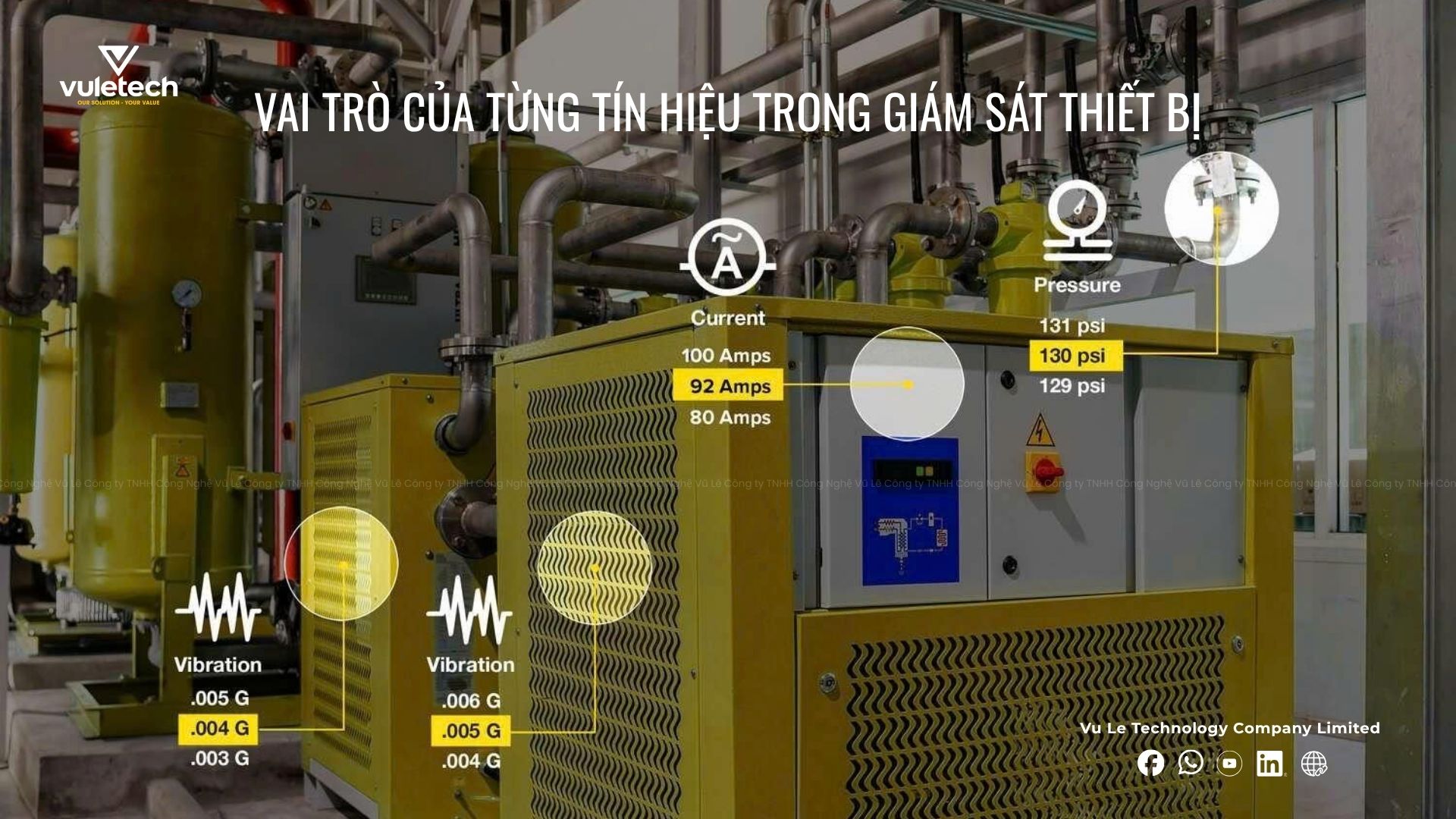
Vibration directly reflects the mechanical condition of rotating equipment. When issues such as unbalance, misalignment, bearing wear, or structural looseness occur, vibration characteristics change before heat or noise develops. Vibration monitoring helps to:
- Detect mechanical faults at an early stage
- Track the degradation trends of motors, pumps, and compressors
- Warn of anomalies before catastrophic failure occurs
» Read more: What is vibration monitoring?
2. Temperature is an indicator of load and friction
Rising temperatures are often associated with friction, poor lubrication, or prolonged overloading. This indicates that the equipment is operating outside optimal conditions. Temperature monitoring helps to:
- Detect motor overloading
- Identify poor lubrication and high friction
- Warn of risks such as winding burnout or bearing damage
3. Electric current reflects electrical status and mechanical load
Electric current provides information on load levels and motor operating efficiency. Abnormal fluctuations can indicate electrical faults or increased mechanical resistance. Current monitoring helps to:
- Detect overloading or mechanical binding
- Identify phase loss or phase imbalance
- Monitor motor operating conditions from an electrical perspective
III. Examples of faults and corresponding signals
Certain typical failure modes can be identified through characteristic changes in specific measured signals. For instance, bearing wear often causes vibration amplitude to rise before the temperature begins to increase; shaft misalignment leads to severe vibration and subsequent mechanical wear; and motor overload manifests as an increase in current, followed by a rise in temperature. Conversely, high friction typically causes a temperature rise before abnormal vibration appears, whereas mechanical jamming can trigger a sudden spike in current accompanied by unstable vibration fluctuations.
Simultaneously analyzing multiple signals provides maintenance teams with a comprehensive view of equipment health, enabling accurate diagnosis of failure causes rather than relying on a single indicator.
IV. Monitoring vibration, temperature, and current for more accurate diagnosis
Implementing simultaneous monitoring of vibration, temperature, and current allows the system to:
- Cross-reference data across signals to enhance diagnostic accuracy
- Reduce false alarms and correctly identify the root cause of failures
- Analyze operational trends and predict equipment lifespan
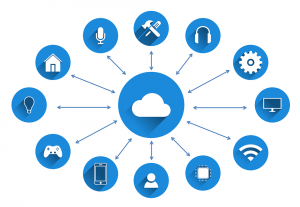
- Collect multiple signals via a unified industrial sensor platform (IO-Link/wireless) and synchronize data to PLCs, MES, or the Cloud in real-time
- Effectively serve high-capacity motors, pumps, compressors, utility systems, and critical rotating equipment in production lines
- Provide a holistic view of equipment status, facilitating early fault detection, maintenance optimization, and improved operational reliability across the entire plant.
Contact Vuletech for a consultation today!
Vu Le Technology Co., Ltd. – Specialist in industrial replacement equipment
» Address: No. 7, Lot C2, Street 659, Phuoc Long Ward, Ho Chi Minh City
» Hotline: (028) 3620 8179 / 3620 8176 / 3620 8177
» Fax: (028) 3620 8178
» Email: info@vuletech.com